Crossout game modes and how matchmaking works
Crossout is not a single queue. The modes reward different builds and different resources, and the system that decides who you face is not the one most new players assume.
How this page is paid for
solaten.online is an independent guide, and it is funded by advertising. Buttons and links marked partner link lead to the official Crossout website through an affiliate network. If you register there after following one, the publisher of this site may be paid a commission. You pay nothing extra, and the commission has no influence on what we write — see our editorial policy.
We are not the game's publisher. This site is not affiliated with, endorsed by or sponsored by Targem Games, Gaijin Entertainment or any related company.
Team missions: the core PvP
Eight players against eight, on objective maps. The recurring formats are Assault, Domination and Encounter — variations on capturing, holding and pushing. They are objective modes, not deathmatches, and a team that plays the objective regularly beats a team that chases kills.
Practically, that means positioning and map awareness matter more than raw damage output. A vehicle parked where it can contest a point is doing more than a faster one hunting stragglers across the map.
Raids and story content: playing against the computer
Raids are co-operative missions for up to four players against computer opponents. Their real function is economic — they are a dependable source of the resources you need to craft — but they are also the sanest place to test a new build. There is also story and Adventure content that can be played alone or with others.
Why we recommend PvE first
A new build in a PvP queue tells you that you lost. The same build in a raid tells you what broke first, because you have time to watch it happen. That is the more useful information.
Brawls and events: the rotating middle
Brawls are limited-time modes with their own rules: racing, arena formats, battle-royale style rounds, and modes that hand everyone a pre-made vehicle. That last category is worth seeking out early, because it removes the garage from the equation entirely — you are playing on skill rather than on inventory.
Because brawls rotate, no guide can tell you what is available today. The in-game mode list is the only reliable source.
See which modes are running
The current mode rotation is only visible inside the game, which is free to download and play. The link goes to the official Crossout website.
Download the game freePartner linkAdvertising. If you create an account through this link, the publisher of this site may earn a commission. It costs you nothing extra and it does not change what is written here.Matchmaking: power score, not experience
The game does not match you on account age or on how many hours you have played. It matches on power score — a number derived from the parts on the vehicle you queued with.
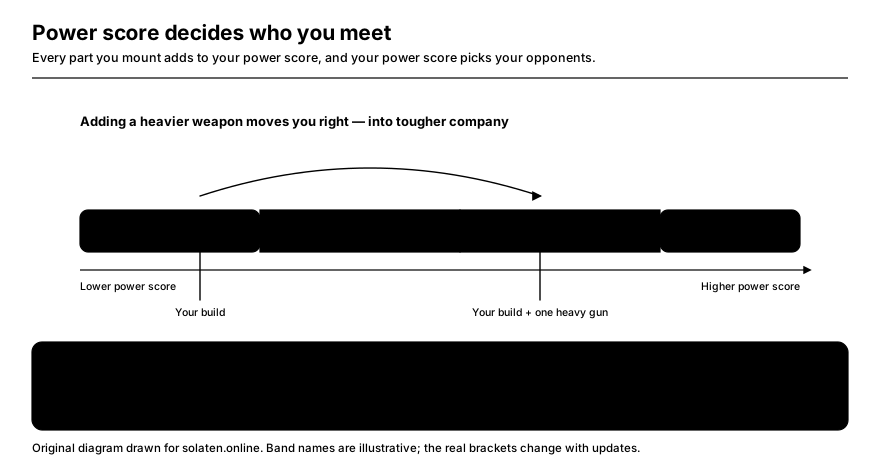
Two consequences follow, and both surprise people:
- You can make the game harder by upgrading. A part that raises your score more than it raises your effectiveness is a downgrade in practice.
- You can keep a second, lighter build. Many players maintain a deliberately low-score vehicle for comfortable matches alongside their best one. There is nothing underhand about this; it is how the system is designed to work.
What we cannot tell you
We do not publish bracket thresholds, reward tables or queue times. Those numbers are adjusted by the developers, sometimes quietly, and a guide that quotes them is misleading within weeks. Everything above describes structure, which has been stable; the numbers are in the game.
Written by Margaret Cook, responsible editor for solaten.online, published by DKA tours, s.r.o.. Published 25 September 2026. Where this page and the game's publisher disagree, the publisher's own information prevails. Corrections: info@solaten.online.