Crossout for new players: how the game actually works
Crossout hands you a pile of scrap and a garage, and then almost nothing else. This guide explains the systems the game never sits you down and explains — energy, power score, local damage, and where parts actually come from — so your first evening is spent learning the game rather than guessing at it.
How this page is paid for
solaten.online is an independent guide, and it is funded by advertising. Buttons and links marked partner link lead to the official Crossout website through an affiliate network. If you register there after following one, the publisher of this site may be paid a commission. You pay nothing extra, and the commission has no influence on what we write — see our editorial policy.
We are not the game's publisher. This site is not affiliated with, endorsed by or sponsored by Targem Games, Gaijin Entertainment or any related company.
Key facts, at a glance
- DeveloperTargem Games
- PublisherGaijin Entertainment (the official site's footer credits Gaijin Games Kft.)
- ReleasedOpen beta on 30 May 2017, after a closed beta in 2016
- PlatformsWindows, PlayStation 4 and 5, Xbox One and Series X|S; a separate mobile version exists for Android and iOS
- PriceFree to download and play, with optional in-game purchases and a player-run market
- GenrePost-apocalyptic vehicular combat with player-built vehicles, online only
Sourced from the official Crossout website and the game's public documentation. Where this page and the publisher's own information differ, the publisher's information prevails.
What Crossout actually is
Crossout is an online vehicular combat game set after a collapse, where you build the thing you drive out of salvaged parts. That last clause is the whole game. You are not choosing a tank from a list. You are bolting a cabin to a frame, hanging armour off it, deciding where the guns go, and then discovering in battle which of those decisions was wrong.
It is developed by Targem Games and published by Gaijin Entertainment. It entered open beta on 30 May 2017 after a closed beta the year before, and it has been updated continuously since. It runs on Windows, PlayStation and Xbox, and there is a separate mobile version — which is its own game, not a companion app.
What it is not: it is not a deathmatch shooter with vehicle skins, and it is not a game you can meaningfully learn by copying a build you saw once. The main player-versus-player modes are objective-based — capturing and holding points, or pushing an attack — and the objective usually decides the match before the kill count does.
Crossout is free to download
The game costs nothing to install and play. You can create an account and build your first vehicle without spending anything; the link below goes to the official Crossout website.
Play Crossout for freePartner linkAdvertising. If you create an account through this link, the publisher of this site may earn a commission. It costs you nothing extra and it does not change what is written here.The anatomy of a build
Every vehicle in Crossout is made from the same handful of part groups. Once you can name them, the garage screen stops being intimidating.
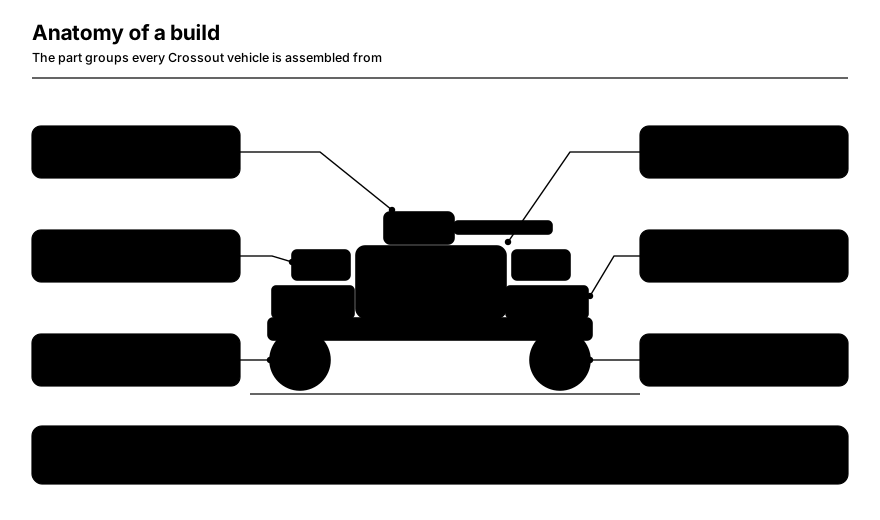
- The cabin is the heart of the vehicle. It supplies the energy your weapons and modules draw on, it carries its own durability, and when it is destroyed, you are out of the round. Cabins come in light, medium and heavy varieties with different speed, tonnage and energy characteristics.
- Movement parts — wheels, tracks, hovers, augers, mechanical legs — determine how much mass you can carry and how the vehicle handles. Fit too few for the weight you have bolted on and the vehicle becomes a slow target.
- Weapons are mounted anywhere you can physically attach them, which means the traversal of a gun buried in a trench of armour is genuinely different from one on a pylon.
- Hardware and modules — generators, coolers, engines, radars and the like — change how the rest of the vehicle behaves, and most of them also consume energy.
- Structural parts are the frames, bumpers and plates that hold everything together and absorb fire. They are cheap, and they are the thing new players use least well.
Energy: the budget behind every build
This is the constraint that shapes every vehicle you will ever make. Your cabin provides a pool of energy. Weapons and most hardware draw from that pool. When the pool is spent, you cannot mount anything else that needs it — no matter how much space or tonnage you have left.
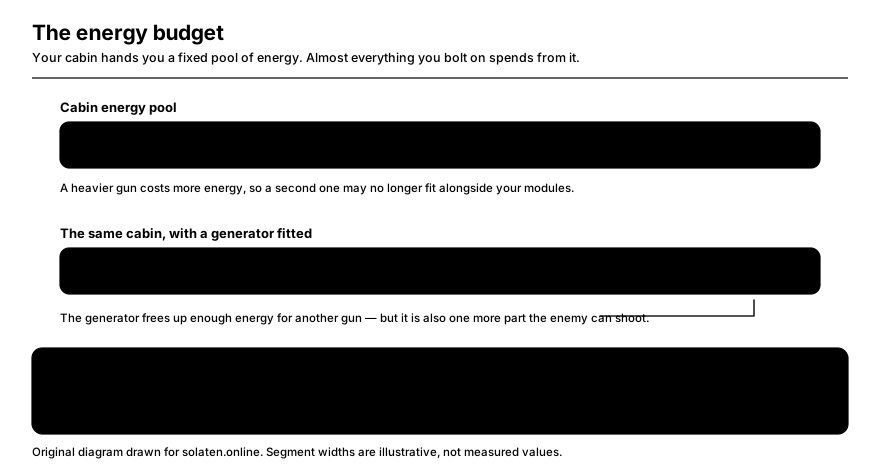
You can enlarge the pool by fitting a generator, and generators are the reason a lot of builds work at all. But there is a catch that catches everyone once: a generator is a part, parts can be destroyed, and when the generator goes, the energy it was supplying goes with it. Anything that no longer has power stops working. A build that depends on a generator can lose a weapon mid-fight without ever taking a hit to the cabin.
A note on numbers
We deliberately do not quote energy values on this page. Crossout's energy system has been rescaled in the past — the developers changed the scale so that a point of energy no longer means what it used to — and older guides that quote hard numbers are a common source of confusion. The figures shown in your own garage are the only ones that are current.
Power score and who you get matched against
Every part you mount contributes to a single number called power score, and power score is what the game uses to decide which opponents you face. Not your account age, not your win rate, not how long you have played. The vehicle you drove into the queue.
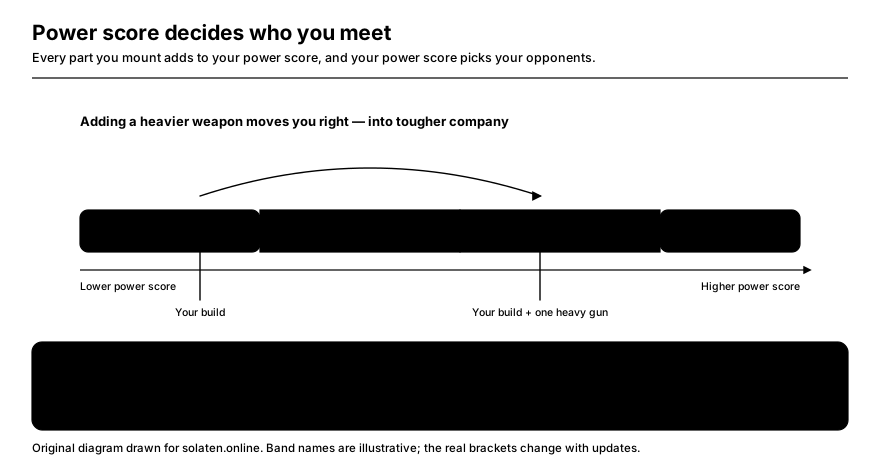
The practical consequence is counter-intuitive and it is the single most useful thing a new player can learn: adding a part you cannot use well makes the game harder, not easier. Bolt an expensive weapon onto a build that cannot power it, aim it or carry it, and you have bought yourself tougher opponents without buying yourself any way to beat them. Players call the opposite approach — keeping power score low while keeping effectiveness high — building “efficiently”, and it is a real skill.
Build your first vehicle
Everything described on this page happens in the in-game garage. Downloading the game and building something is free; the link goes to the official Crossout site, where you can create an account.
Download CrossoutPartner linkAdvertising. If you create an account through this link, the publisher of this site may earn a commission. It costs you nothing extra and it does not change what is written here.How vehicles come apart
Damage in Crossout is local. Shots hit specific parts and destroy those parts. A gun that is exposed can be shot off while the rest of your vehicle is untouched; wheels can be removed one at a time until you cannot steer. The round ends for you when your cabin's durability runs out — everything else is attrition on the way there.
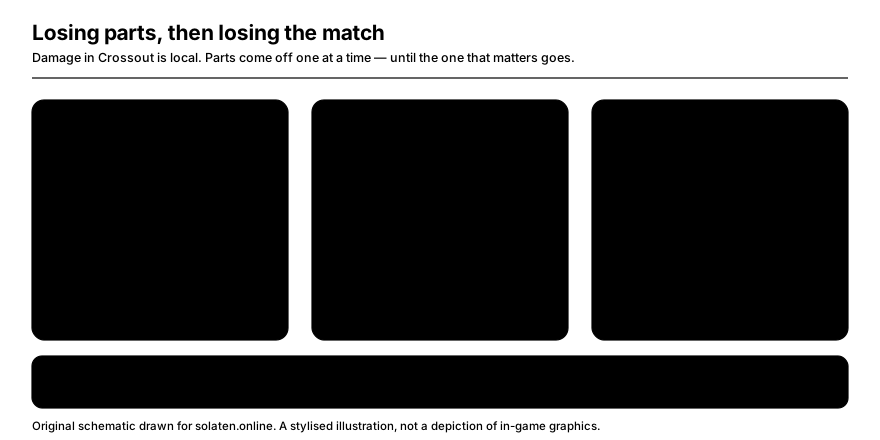
This is why placement matters more than the sheer quantity of armour. A weapon recessed into the body, with structural parts either side of it, survives exchanges that an identical weapon on an exposed mount does not. It is also why the cheapest parts in the game — plain structural pieces — are worth as much attention as the expensive ones.
The modes, and what each one is for
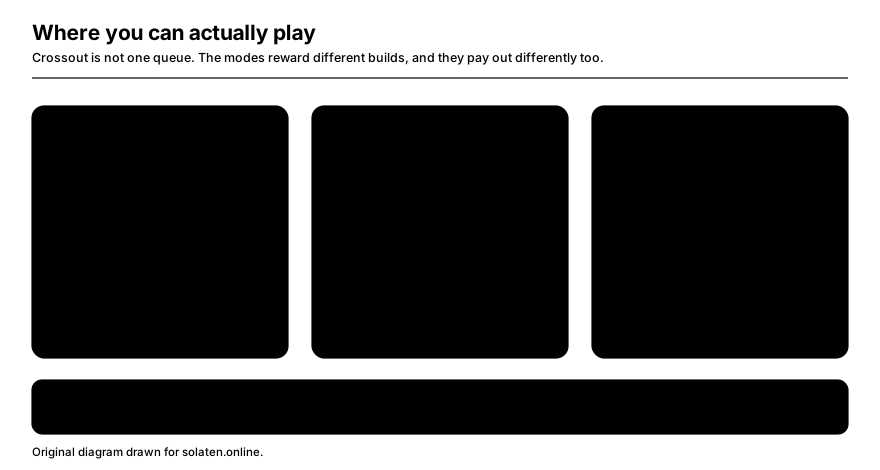
- Team missions (PvP). The core of the game: eight players against eight, on objective maps. Assault, Domination and Encounter are the recurring formats. Matchmaking follows your power score.
- Raids and story content (PvE). Co-operative missions for up to four players against computer opponents, played mainly for resources. Raids are a safer place to test a new build than a PvP queue, and they are where a lot of your crafting material will come from.
- Brawls and events. Rotating, limited-time rule sets, often with pre-made or restricted vehicles — racing, arenas, battle-royale style formats. Because your garage matters less in many of them, they are a good way to play while you are still poor.
Resources, crafting and the player market
There is no experience bar that hands you parts for turning up. Everything you own comes out of a loop.
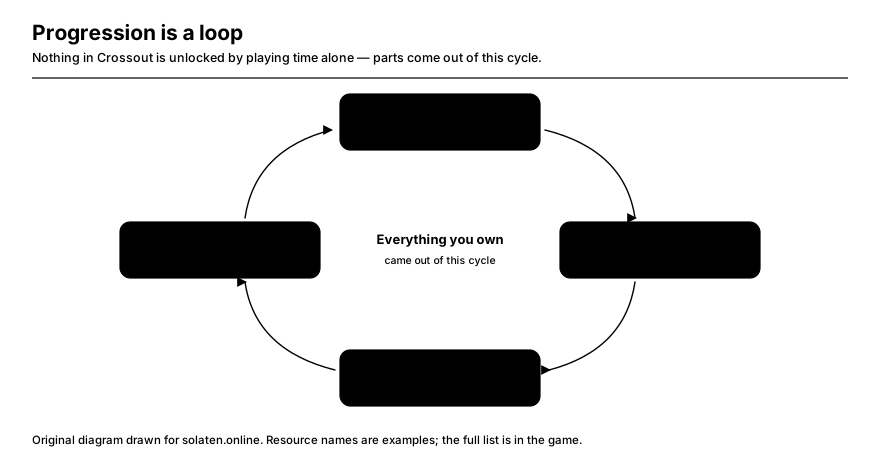
Battles pay out resources. Resources are spent either at a faction workbench — which usually also requires the blueprint and enough reputation with that faction — or on the in-game market, where players buy and sell parts from each other for coins at prices that move with supply and demand.
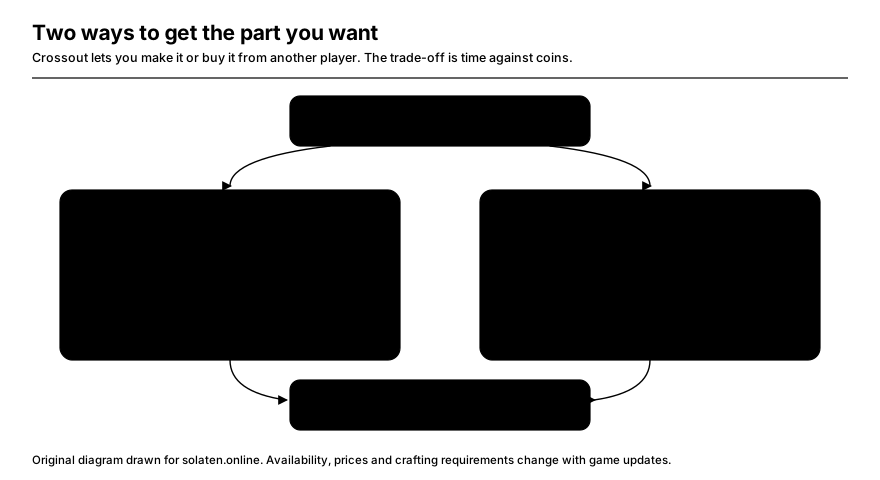
Because the market is player-driven, the price of a given part is not a fixed property of that part. It is a snapshot. Any guide — including this one — that told you what something “costs” would be out of date within weeks, which is why we do not quote prices. Check the market in-game.
The rarity ladder — and the cost curve
Parts are graded in rarity tiers. From the bottom: Common, Rare, Special, Epic, Legendary, and at the top Relic. (The pieces you are handed at the very start of the game sit below even Common.) Relic parts are the rarest in the game and are built from specific fragments using uranium.
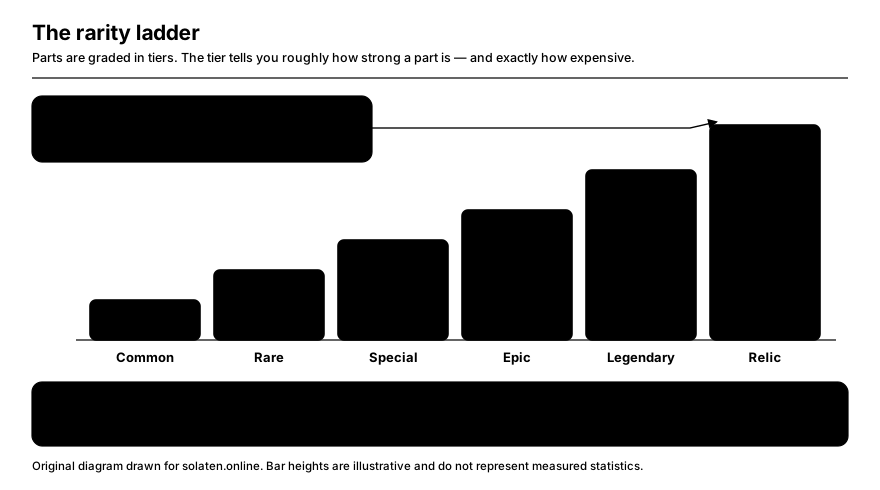
The important thing about the ladder is that the cost curve is far steeper than the performance curve. Moving up a tier can multiply the price many times over for an improvement that is real but incremental. Combined with what power score does to your matchmaking, that means the rarest part you can afford is very often the wrong purchase.
Your first session, step by step
- Finish the in-game introduction before you touch anything else.
It hands you starter parts and shows you the garage interface. It will not teach you energy or power score — that is what the rest of this page is for.
- Open the garage and read one cabin's stats properly.
Note its energy, its tonnage and its mass limit. Those three numbers decide what the rest of the build can be.
- Build something small and complete rather than something big and half-finished.
One weapon you can power, enough movement parts for the weight, and structural parts filling the gaps beats two guns on a chassis that cannot move.
- Hide the weapon.
Put structural parts either side of it. Then look at the vehicle from the front and ask what an enemy can see.
- Play raids and brawls first.
They are more forgiving than the PvP queue, they pay resources, and losing does not feel like being farmed.
- Only then queue for missions.
And when you lose, look at what was destroyed first. That part was in the wrong place.
Ready to try it?
The game is a free download and the account is free to create. Everything in this guide can be tried in the garage before you ever queue for a match.
Get started on the official sitePartner linkAdvertising. If you create an account through this link, the publisher of this site may earn a commission. It costs you nothing extra and it does not change what is written here.Five mistakes that cost new players the most
Chasing rarity
A Legendary weapon you cannot power, aim or carry is worse than a Rare one that fits your build — and it raises your power score, so it also gets you harder opponents.
Ignoring structural parts
They are the cheapest things in the game and the most efficient armour you will ever have. Builds with visible gaps around the weapons lose those weapons.
Over-weighting the vehicle
Mass limit and tonnage are not suggestions. Exceed them and the vehicle crawls; a slow vehicle in an objective mode contributes very little.
Relying on a fragile generator
If half your firepower goes dark the moment a generator is destroyed, the build is one lucky shot away from being useless.
Copying a build from an old video
Balance changes, the energy scale has been rescaled in the past, and the market moves. A build from two years ago may not even be legal to assemble as shown.
Spending before understanding
Coins spent in the first week are usually spent on the wrong part, because you do not yet know what role you enjoy playing.
Is it really free? What actually costs money
Yes, genuinely: Crossout is free to download and free to play. The official site describes it as a free-to-play title, and you do not need to pay anything to create an account, build vehicles or enter battles.
What money buys is time and convenience. There are in-game purchases, and there is a player-run market where parts change hands for coins. A player who spends can assemble a strong vehicle much faster than a player who grinds resources for it. Whether that matters to you depends on the power score bracket you end up playing in, since spending tends to move you up the ladder into tougher matches rather than making the matches you already play easier.
We will not tell you that the game is “not pay-to-win” or that it is. That is a judgement about a live, frequently rebalanced economy, and anyone who states it as a fact is overreaching. What we can say factually is: nothing is behind a mandatory paywall, and money shortens the loop described above.
Sources, corrections and limits of this guide
This page describes systems, not exact statistics. Wherever a figure would date quickly — energy values, part prices, bracket thresholds, reward amounts — we have deliberately left it out and pointed you at the game instead. That is a choice about accuracy, not an omission.
Sources used
- Crossout — official website, crossout.net (platform list, free-to-play status, developer and publisher credits, current modes and factions).
- Crossout — official news and developer posts, including the announcements covering changes to the system of energy consumption and energy supply of parts.
- Community reference documentation for Crossout (rarity tiers and the energy mechanic), cross-checked against the official material above.
- General encyclopaedic coverage of the game for release dates and platform history.
If this page and the publisher disagree
Crossout is a live game and its rules change. If anything on this page contradicts the game itself, its official website or its publisher's announcements, the publisher's own information prevails. If you spot something wrong here, write to info@solaten.online and we will correct it — our corrections procedure explains how.
Written by Margaret Cook, responsible editor for solaten.online, published by DKA tours, s.r.o.. Published 25 September 2026. Last reviewed 25 September 2026. This site is independent and is not affiliated with, endorsed by or sponsored by the publisher of Crossout.